What does your fifth webshop really cost?
When you run several brands you are choosing between two cost curves. One multiplies with every shop you add. The other stays roughly flat. We will run the numbers for your portfolio.
Four cost lines that are billed per shop
The platform licence is rarely the problem. These four lines decide whether your costs grow with every brand you add.
Apps billed per store
This is the real multiplier. Install the same reviews app and feed manager across fifteen storefronts and you pay fifteen times. Even a lean stack at €300 per store adds €4,500 a month.
Storefronts beyond your allowance
Shopify Plus covers your main store plus nine expansion stores. Five brands selling in three countries each is fifteen storefronts, so a third falls outside the allowance at roughly $300 per month each.
Themes and currency fees
Each live expansion store needs its own theme licence. Selling outside your primary currency carries a conversion fee of around 1.5%: €7,500 a year on €500,000 of foreign turnover.
One integration per store
Every separate store needs its own connection to your ERP and warehouse. On a single instance you share one integration layer, however many brands run on it.
The difference is not the price. It is which lines multiply
On Shopify, a store is a tenant with its own admin, catalog, theme, apps and settings. Plus lets you run several under one contract, but they remain separate systems that happen to share a bill.
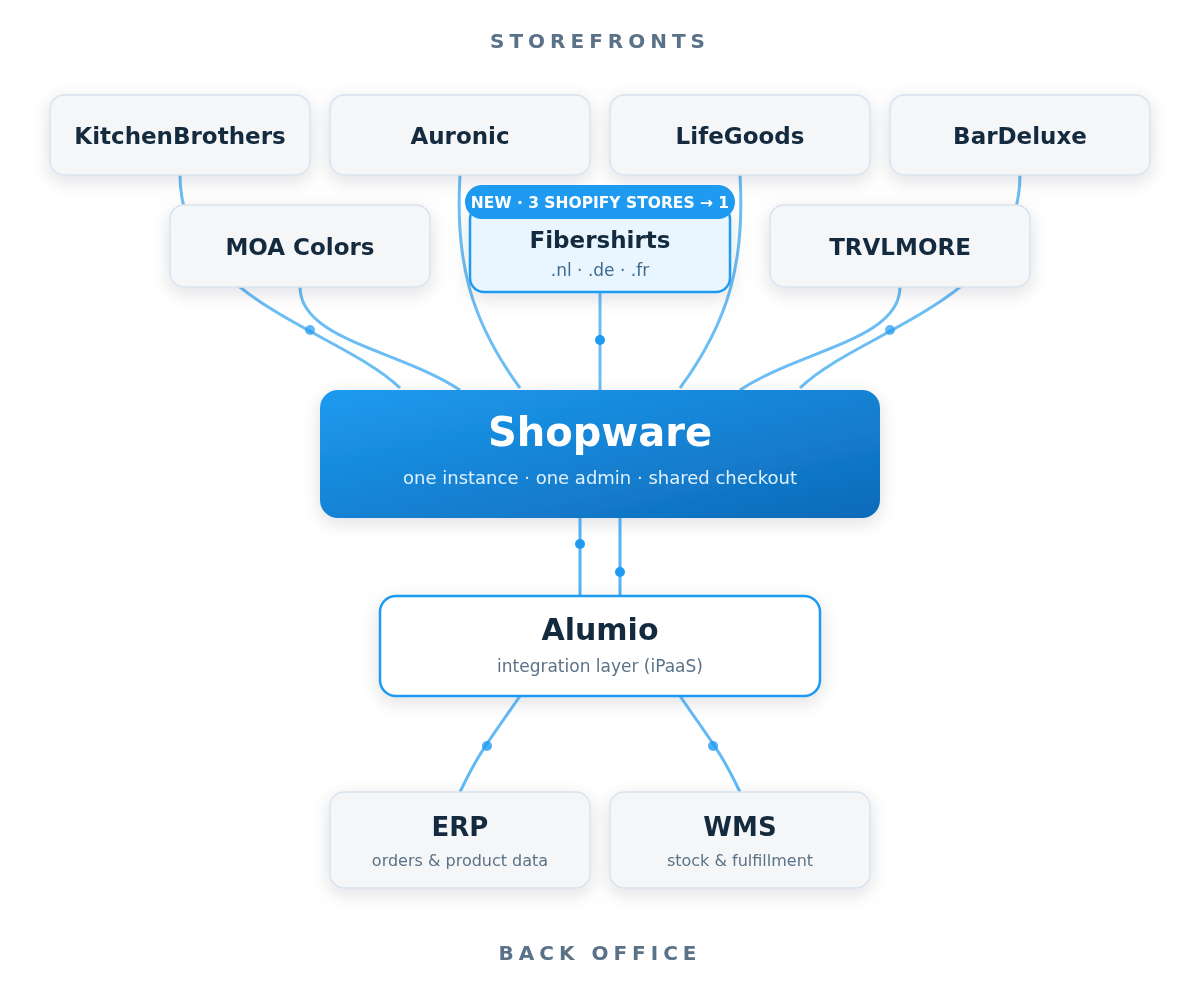
On Shopware, a storefront is a sales channel inside a single instance. Each channel gets its own domain, theme, language and currency, while the catalog, customer data, integrations and infrastructure sit underneath, shared.
That is why the curves diverge. On one side the heaviest cost lines are per store. On the other they are per instance, absorbed by the portfolio.
Five brands, three countries: what it costs per month
This models five brands selling in three countries each, using published list prices, assuming the portfolio is above €1 million GMV. It excludes development and payment processing, which apply to both.
- Fifteen separate storefronts — licence from €2,250 per month plus roughly $300 per store above the allowance, apps at 15 × €300 = €4,500, one integration per store. Indicative total: €8,000 per month and up.
- One instance — Shopware Rise from €600 per month with unlimited sales channels, one hosting environment at €500 to €1,500, plugins licensed per instance at €300 to €500, one integration layer for everything. Indicative total: €1,500 to €2,500 per month.
Worth knowing: Shopware prices on gross merchandise value, not on store count. A Fair Usage Policy has applied since March 2025 above €1 million GMV, measured per instance. A multi-brand group is therefore on a commercial plan from day one. But an eighth brand does not add a licence line. It adds revenue, which is the thing you wanted to grow anyway.
The most expensive part is nowhere on the bill
Another admin to log into. Another release to test. Another environment to patch. Product updates and campaigns repeated per store, and reporting that means exporting from each shop and reconciling in a spreadsheet.
From three subscriptions to one extra channel
LifeGoods runs seven brands as separate storefronts on one Shopware instance, managed by Memo. When the anti-sweat apparel brand Fibershirts joined the group, it arrived as three separate Shopify stores for the Netherlands, Germany and France: three subscriptions, three sets of apps, three admins, and every product change done three times.
We migrated it onto the existing instance and consolidated it into one multi-language storefront. Because the integrations were already there, no new ERP or warehouse connection was needed. The acquisition went from three extra systems to run to one more channel on a platform the team already knew.
On working together
“What stood out most was how consistently flexible Memo remained throughout the entire project.”
Questions about the numbers
When do separate stores still make sense?
When brands genuinely need to be separate: distinct legal entities with their own payment processors, regional teams with full control over assortment and pricing, or a brand you intend to divest. A shared instance also means shared risk, since a platform-wide issue touches every brand at once.
Does the €1 million Shopware threshold apply per brand or per instance?
Per instance. Shopware consolidates every sales channel and storefront on a single installation, so all brands count toward the same threshold. A multi-brand group will be on Rise, Evolve or Beyond regardless of how the revenue splits across brands.
Doesn't consolidating cost more because GMV pools?
That is an honest counterpoint. In theory you keep each installation below €1 million and pay nothing. In practice that means duplicating hosting, plugins, integrations and admin work across all of them, which overtakes a Rise subscription long before you approach the threshold.
Can I run several brands from one Shopify store instead?
Not really. Shopify Markets handles multiple countries within one store, but it is built for localisation rather than for distinct brands with their own identity, assortment and domain. Separate brands generally mean separate stores.
Is migrating multiple shops onto one platform disruptive?
It is a project, but it does not have to happen at once. Brands are usually moved one at a time onto an instance that is already live, which keeps each go-live small. The heaviest work, the ERP and warehouse integration, is done once and then reused by every brand that follows.
Start by adding up what you pay per shop today
Licences, apps, themes, integrations, and the hours your team spends doing the same task twice. That total is usually larger than expected, and it is the number a multistorefront setup is measured against. We are happy to run it with you.