Five brands, entering the same product five times?
A PIM brings all your product data together in one place. You add the information once. Then you publish it to every webshop, every language and every sales channel. Each brand still gets its own story.
What it looks like when this goes wrong
You do not have your assortment once, but as many times as you have shops. These situations almost always occur together.
Data lives everywhere and nowhere
Product copy in the webshop, prices from the ERP, images in a separate folder and specifications in a spreadsheet someone once started.
Everything written twice
Two brands sell partly the same article under a different name and positioning. So you write it twice, and update it twice.
Nobody knows what leads
When two shops disagree, the one updated last wins. Data quality is nobody's explicit responsibility.
Your team copies instead of sells
A new supplier list means a week of retyping before anything goes live. Content people have become copy-paste people.
Every extra shop makes it worse, not equal
One webshop with a spreadsheet works fine. Two shops still work. But from three or four shops it starts to break, because the amount of work grows with shops times languages times channels, not with your revenue.
What happens next is predictable: teams fall behind, quietly pick one important shop to keep current, and let the rest go stale. You do not see the damage in an error message, but in conversion on the shops nobody updates any more.
Your e-commerce platform does not solve this. It is built to sell, not to manage, enrich and distribute product data across brands that each speak their own language.
One source, multiple brands, its own story per shop
With a PIM (Product Information Management) you record the product properly once: specifications, images, documents, variants and relations. On top of that come brand and channel variants: the same articles, but with a title, tone and set of images that fit that brand.
- Product change — done once and applied everywhere, instead of manually per shop
- New brand or language — a variant on your existing source, no rebuilding the assortment
- Data quality — one standard you can measure, instead of differing per shop
- Ownership — roles and workflow per brand, instead of unclear
- Marketplace feeds — channel output from the same source, no separate exports
We work with Ergonode: a PIM designed for teams that work with enrichment and workflow, not just storage. We set up the data model, decide what leads, and make sure it connects to your existing systems.
From three separate shops to one storefront for three countries
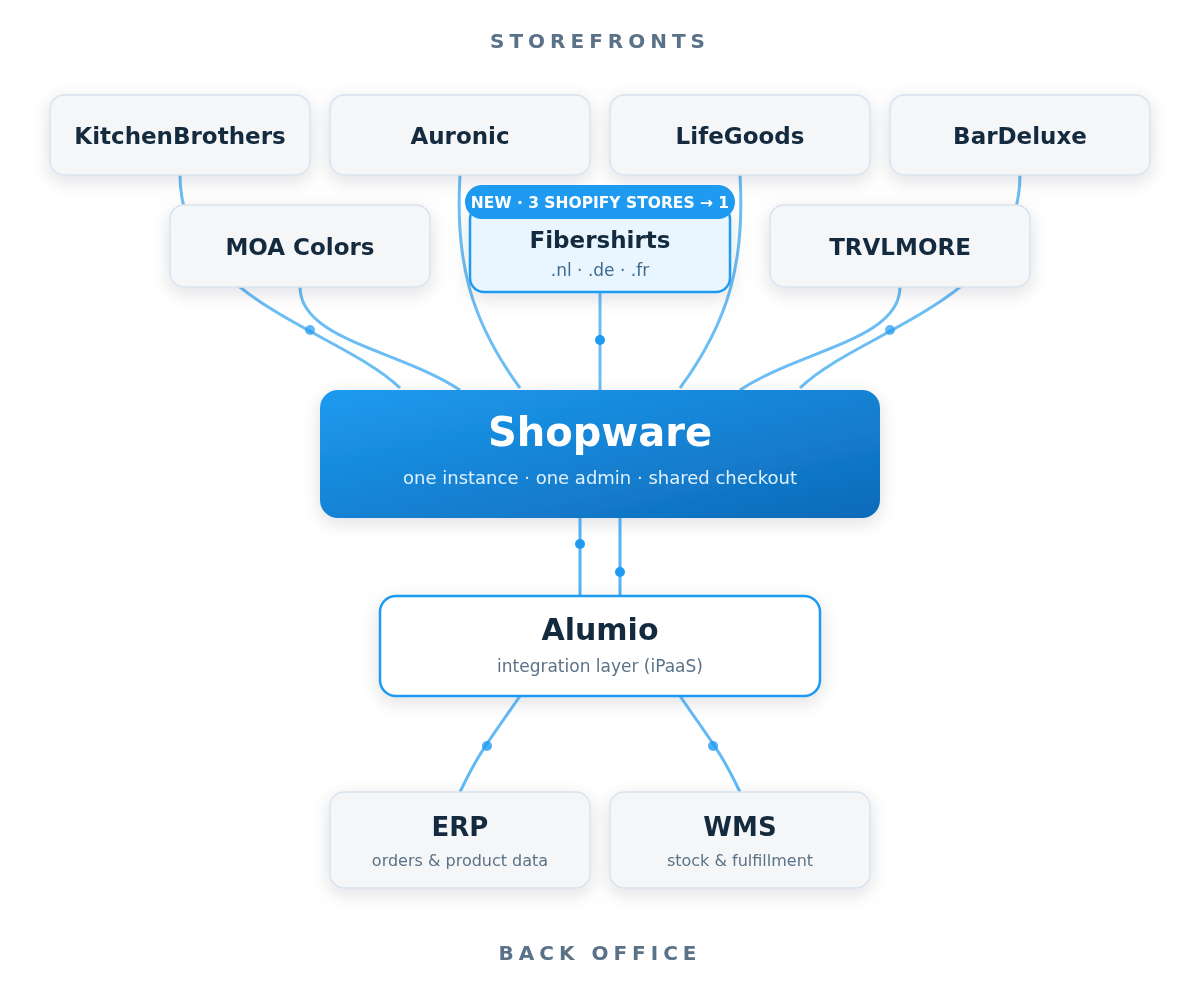
When the brand Fibershirts joined the group, it had three separate Shopify stores: for the Netherlands, Germany and France. That meant three subscriptions, three sets of apps and three admins. Every product change, price update and campaign had to be done three times.
We migrated Fibershirts onto the existing Shopware environment and consolidated the three country shops into one multi-language storefront. The effect: a product update or campaign is now rolled out once for three countries. An acquisition went from three extra systems to one more channel on the platform.
On working together
“What stood out most was how consistently flexible Memo remained throughout the entire project.”
Questions about PIM
What is the difference between a PIM and my ERP?
Your ERP is built for transactions: article numbers, prices, stock and logistics. A PIM is built for the selling side: copy, images, specifications, variants and enrichment per channel and brand. They complement each other; the ERP usually stays leading for the hard data.
Can I use one PIM for multiple brands with their own identity?
Yes, and that is exactly where the return sits. You record the product once and create a variant per brand or channel with its own title, tone and imagery. Brands stay distinctive without you maintaining everything twice.
Do I need to replace my webshop to start with a PIM?
No. A PIM sits alongside your existing platform. You do not need a migration to start cleaning up and centralising your product data.
How many products before a PIM pays for itself?
The number of products matters less than the number of channels and how often things change. 500 products across four shops and three languages is a stronger case than 20,000 products in one shop.
What does a PIM project cost?
The licence depends on the number of products, users and integrations. The implementation depends on the state of your data today. After the product data scan we give a substantiated range instead of a standard price.
Start by knowing what it costs you today
In a 30-minute conversation we map your current product data flows and roughly calculate what the manual work costs you per month. No sales pitch, but a number.